







What if your control panel could think on its feet?
Picture this: You’re monitoring a production line when a motor drive begins to draw irregular current. Before you even step away from your workstation, the panel has already reacted. It has isolated the fault, rerouted the process, and issued a detailed alert to your phone.
No halt. No hazard. No scramble.
This isn’t a fantasy of future technology. It’s the evolving reality of what we might call self-healing control panels: intelligent systems designed to not only identify faults but to manage them automatically in real time.

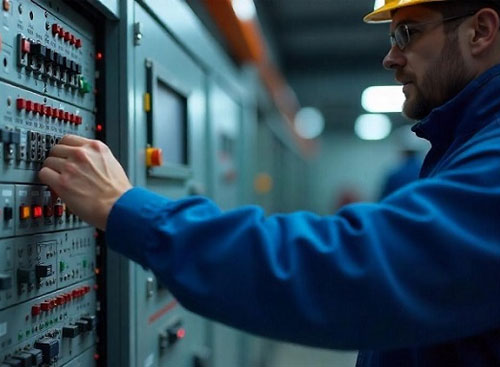
Industrial control panels are the brains of modern industry. AI image used courtesy of C3Controls
The Real Problem: Fragile Control Systems
Control panels are the undisputed brains behind the whole industrial show. You want machines to do their thing without going haywire? That’s up to the panel. Except for one major problem: many panels are built (or repaired over time) as if everyone’s just crossing their fingers, hoping things don’t blow up or cause a fault. Scheduled maintenance, backup plans, and spare part inventories all help, sure, but try dealing with a system that needs to think on its feet, and you’ll see where the cracks start showing.
One fried relay or a PLC that decides to throw a tantrum, and suddenly production lines are at a standstill, error messages that read like hieroglyphics flash on the HMI, and people start poking around where it may or may not be safe. As you add more machines with fancier tech, the price of errors or just plain bad luck continues to skyrocket. Nobody’s got time (or budget) for that kind of mess.
What Does “Self-Healing” Mean in the Real World?
“Self-healing” definitely sounds like a fancy buzzword devised by the marketing team during a meeting, doesn’t it? But in the land of control panels, this strategy actually has some power behind it.
Somewhat contrary to the title, a self-healing panel doesn’t just slap a bandage on the busted hardware and call it a day. Here’s what it actually does:
- It picks up a signal the second something starts to go sideways.
- It hunts down the source of the problem before things get out of hand.
- It’ll shuffle the traffic around, using backups and redundant routes to keep things running.
- And finally, it will tell the humans what’s actually going on—logs, alerts, the works.
Basically, imagine your control system with lightning reflexes and a sixth sense—ready to dodge trouble and keep the show going even when problems strike. Self-healing doesn’t mean things never break. It just means that mess-ups won’t automatically wreck your day.
Core Building Blocks of Self-Healing Control Panels
It’s not enough to simply claim adherence to a strategy; you need to understand how to implement the key features that are designed for the future.
1. Modular Panel Architecture
Control panel enclosures today are increasingly built to UL508A control panel best practices, with considerations for thermal zones, diagnostic visibility, and module segmentation.
Each module, whether it's a relay, VFD, power supply, or I/O interface, is installed as an independent, hot-swappable unit.
Advantages of modular design:
- Fault containment is localized. One module doesn't bring down the system.
- Swapping components takes minutes, not hours.
- Maintenance becomes structured and systematic.
Most control panels already conform to UL508A and IEC 60204 standards, with support for segmented DIN rails, integrated bus systems, and internal zoning. All of these promote this self-healing architecture.
2. Predictive Maintenance with IIoT
You can’t fix what you can’t see, and you can’t prevent the problems you can’t predict. That’s where the Industrial Internet of Things (IIoT) and predictive analytics come in.
Embedded sensors now monitor:
- Electrical load fluctuations
- Component temperature
- Vibration and motor signature changes
- Signal noise or data transmission lags
These sensors feed data into edge analytics platforms that enable predictive maintenance in IIoT environments, shifting maintenance strategies from reactive to proactive. For example:
- A bearing that shows increased vibration over three weeks is flagged for inspection
- A terminal block heating abnormally triggers a preemptive shutdown command
This changes maintenance from reactive guesswork to precise planning, where faults are caught long before symptoms reach critical levels.
3. Smart Diagnostics and Fault Isolation
The final, and perhaps most transformative, piece of the puzzle is intelligent diagnostics.
Rather than a basic “Fault” light or a cryptic HMI error code, self-healing systems deliver:
- Clear alerts with component-specific failure data
- Automatic isolation of affected modules or circuit paths
- Load balancing or backup engagement to sustain the operation
Control software, whether integrated into a PLC or distributed across a SCADA system, can reassign logic pathways, power channels, and process variables on the fly. This isn't just logical, it's designed with surgical precision.
Even in compact systems without a full PLC, programmable relays for automated fault control offer built-in timers, counters, and basic diagnostic logic, making fault detection and response more accessible for smaller applications.
Just as the human body redirects blood around a blocked artery, a smart control system can reroute tasks around failed circuitry.
Protocols like Ethernet/IP, PROFINET, and DeviceNet allow high-speed, fault-tolerant communication between components, ensuring diagnostics and rerouting occur within milliseconds.
Real-World Scenario: When Systems Self-Manage
Let’s illustrate this with a production-floor example.
Facility: Industrial bottling plant
Task: Conveyor system speed regulation
Incident: A motor drive shows signs of electrical wear with uneven current and temperature spikes
Previous Legacy Outcome:
- The motor halts. Conveyor stops.
- The issue is diagnosed manually.
- Downtime stretches into hours.
New Self-Healing Outcome:
- IIoT sensors pick up abnormal readings
- Drive is isolated within seconds
- Backup drive assumes the load via automated control logic
- A notification is sent to maintenance and control personnel
- The faulty drive is replaced at the next shift change with no production loss
Why It Matters: Safer, Smarter, More Reliable Operations
Here’s the business case behind the buzz:
Downtime Reduction
Early adopters report up to 30 percent fewer unplanned outages thanks to smart diagnostics and automated rerouting.
Workplace Safety
Fewer emergency shutdowns and less time spent around live panels mean safer technicians and engineers.
Predictive Cost Savings
Component-level alerts let teams perform just-in-time replacements rather than expensive overhauls.
Enhanced OEE
Overall Equipment Effectiveness improves when faults don’t bring production to a standstill.
Where It’s Headed: The Future of Fault-Tolerant Design
Self-healing panels aren’t a luxury. They’re the natural evolution of connected, smart manufacturing. Here’s what’s pushing the frontier:
- AI in PLC Logic
Advanced logic blocks that adjust based on historical trends and real-time loads - Digital Twins
Virtual models of control systems allow engineers to simulate fault conditions and optimize recovery strategies before deploying physical hardware - Self-Diagnostic Components
I/O terminals and power modules with internal sensors that continuously self-evaluate and report degradation - Edge-Based Decision Making
Localized fault handling minimizes latency and cloud dependence, which is critical for time-sensitive applications
The roadmap to implementation is formalized in NIST guidance on digital twins, which outlines use cases, interoperability standards, and the role of digital twins in enabling resilient control systems.

Design Questions for Engineers & Integrators
If you’re evaluating or designing new control panels, consider asking:
- Are fault zones clearly defined and isolated within the panel?
- Do I/O modules or drives have built-in diagnostics and communication feedback?
- Is the system capable of dynamic rerouting in case of device failure?
- Are we monitoring predictive maintenance data points beyond just runtime hours?
- Can the panel be remotely diagnosed and updated?
Equipment is going to break. That’s just life. But sitting around waiting for disaster? We can do better. We already made machines that work when everything’s perfect. Now is the time to make them tough enough to handle the mess.
Bottom line? The future’s not just smart. It’s stubborn. It refuses to quit. And honestly, that’s what we need: systems that’ve got their own back.