






For several decades, the task of managing plant safety, reliability, and productivity in the process and energy industries has been realized through DCS platforms that orchestrate complex manufacturing and other industrial processes in an essentially supervisory role.
As industry shifts from a digital-first agenda toward systems built on and around human-centered collaboration, the role of automation is widening. Rather than just faster processors or more sophisticated interfaces, progress now prioritizes building operations that are intelligent, adaptive, and agile, and, most importantly, designed to work with people.
Evolving from Industry 4.0
The concept of Industry 4.0 leverages technologies including IoT and machine-to-machine connectivity, along with wireless and cloud-based data analytics, to realize more autonomous, interconnected manufacturing and process operations.
The next generation of automation systems builds on these foundations, harnessing frontier tech trends like hyper-connectivity, AI/ML, digital twins, robotics, and virtualization. While the drivers for Industry 4.0 were primarily focused on technology and efficiency, the conversation has now been broadened to embrace societal goals, namely, well-being and sustainability. As described by the EU, the worker is placed “at the center of the production process and uses new technologies to provide prosperity beyond jobs and growth while respecting the production limits of the planet”.

Human-centered collaboration is a pillar of the next evolution of industry. Image used courtesy of Adobe Stock
From a plant operations perspective, this redefines expectations of the purpose and capabilities of the automation system, with a strengthened emphasis on the successful co-dependency between humans and machines. From an earlier focus on speed and efficient task performance, the DCS is now re-cast as an intelligent, collaborative platform. Sustainability and customization are prioritized in this new environment, where cutting-edge technologies mesh with human creativity and oversight to support more agile decision-making.
Embedding System-Wide Integration
This progressive evolution in the role and capabilities of the DCS is characterized by the integration of data and decision-making mechanisms right across the plant. Automation platforms have traditionally represented clusters of essentially isolated control nodes, where data and insights within each functional silo have little or no impact on their neighbors. Today, we’re rethinking individual automation cells as constituent parts of a larger organism, where rich data is exchanged continually between field devices, controllers, processes, production lines, and higher-level enterprise applications.
In this evolved model, real-time and historical process, monitoring, and maintenance data continuously feed and interact with powerful analytics driven by AI/ML, with storage and processing hosted either on edge devices at the point of data production or in the cloud. From a business perspective, this allows plant owners to look beyond individual processes and make smarter, safer, and more valuable decisions that blend data-driven insights with human judgment.
Progressive Modernization Without Disruption
A desire to reap the commercial benefits of cutting-edge tech and realize the full vision of greater human centricity is dictated by the practicalities of plant operations. Many industrial facilities are brownfield sites, where installed automation systems comprise a mix of old and new equipment. Modern instrumentation devices often co-exist with older legacy products using diverse communication protocols and no longer enjoying the support of the original manufacturer. The big challenge facing plant owners is how to upgrade, replace, or reengineer individual devices and systems while minimizing profit-sapping disruption to production or endangering staff.
As envisioned by industry leaders like ABB, an evolution of traditional automation systems will allow customers in the process industries to benefit incrementally from advances in technology without jeopardizing their current investments. In this new model, progressive modernization is made quicker, easier, and less risky through a ‘separation of concerns’ that facilitates innovation without affecting the continuity of core production processes and applications. Here, the automation system can be considered as two separate but closely intertwined environments, each performing quite distinct but complementary roles.

Brownfield challenges center around upgrading legacy equipment with minimal disruptions. Image used courtesy of Adobe Stock
The control environment is a robust, stable, cyber-secure core running mission-critical real-time automation applications. It’s complemented by the digital environment, an agile cloud-centric space where process, monitoring, and maintenance data is made readily accessible to higher-level applications, including monitoring & optimization and advanced analytics. Within the digital environment, innovation can flourish without compromising the integrity of primary process control functions. Upgrades, additional functions, and optimization of existing assets and resources can be modelled and tested through virtualization and digital twin simulations prior to deployment. Crucially, all this can be achieved without halting production, endangering costly equipment, exposing systems to additional cybersecurity threats, or compromising staff safety.
Doing More With Real-Time Data
Process monitoring, optimization, and other plant functions have traditionally relied on decision-making informed by historical data generated by connected instrumentation systems. This reactive stance is no longer adequate to meet the demands of today’s process industries, where business advantage often relies on the availability of process parameters and equipment status in real time. This need is further amplified as plants become larger and more complex, with more devices, more data, and more protocols to manage.
The pervasive digitalization of industrial plant operations now gives operators powerful tools to harvest, store, analyze, and act on instrumentation data collected across all their distributed assets. AI-driven predictive analytics can help to flag the imminent failure of a connected device or spot small instabilities in a tightly controlled process. Real-time edge processing close to the point of data production is complemented by powerful analytics hosted securely in the cloud or on premises. Together, they give plant owners unprecedented ability to detect trends, forecast future events, and plan remedial strategies without interrupting production or compromising confidence in operations.
Human in the Loop
While automation systems are evolving rapidly to become more autonomous, the contribution and value of human workers is as great as ever.
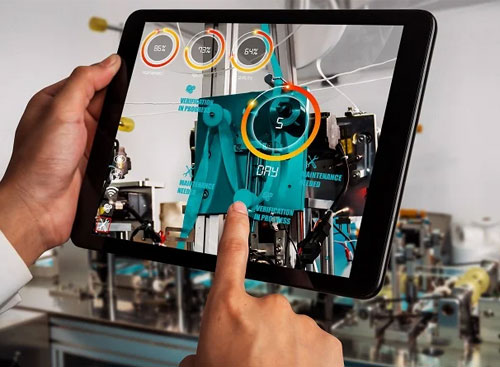
Tightened collaboration between people and machines re-frames the importance of the human operator, equipping them with digital handrails to enhance their own natural skills and capabilities. This notion of the ‘augmented operator’ sees workers making extensive use of immersive interfaces, AI-driven insights, and augmented/extended reality (AR/XR) to guide their own judgment, enabling them to work more safely and efficiently, with less fatigue and fewer mistakes.

AR insights keep the operators informed in real time. Image used courtesy of Adobe Stock
An engineer in the field, for instance, can converse via voice and video with expert colleagues at base, working together to resolve an issue while sharing visualizations of real-time data assisted by AI-driven interpretive tools. Traditionally, reactive monitoring and maintenance regimes are also re-invented, with data-led insights helping human workers build and execute smarter predictive maintenance strategies.
A Sense of Security
As automation systems become smarter, connectivity between devices, systems, converged IT/OT networks, and applications heightens plants’ exposure to cybersecurity risks that could threaten business continuity, profitability, and corporate reputation. The evolution of control platforms accordingly prioritizes security by design, engineered around intrinsically secure system architectures and containerized modules that minimize the danger of threats spreading unchecked between different functional areas. Preserving the integrity of core functions demands a zero-trust cybersecurity stance, with robust measures to authorize and continuously validate network activity.
A Commitment to Sustainability
Energy efficiency and the need to minimize environmental impact are intertwined with commercial competitiveness for every industrial organization. Plant operators are embracing electrification as part of society’s broader energy transition to a low-carbon future enabled by clean and plentiful sources of renewable power. And as automation systems evolve, they’re playing a central role in making processes more energy efficient, helping to reduce emissions and waste and enabling companies to deliver on increasingly strict environmental, social, and governance (ESG) agendas.
Ensuring Success
The evolution of today’s automation systems plays a central role in helping organizations successfully realize the opportunities of closer human-machine collaboration. For manufacturers and other commercial producers, however, it’s critical that their own technological journey is carefully paced. By introducing innovation incrementally, organizations can objectively measure the benefits as a guide to the next steps in their strategy.
With automation platforms touching virtually every aspect of modern plant operations, the potential benefits of modernization are immense. And by working with an expert partner like ABB, process organizations can ensure that their own evolution is smooth and sustainable, while recognizing and reinforcing the enduring value of human expertise as a driver for long-term business success.