







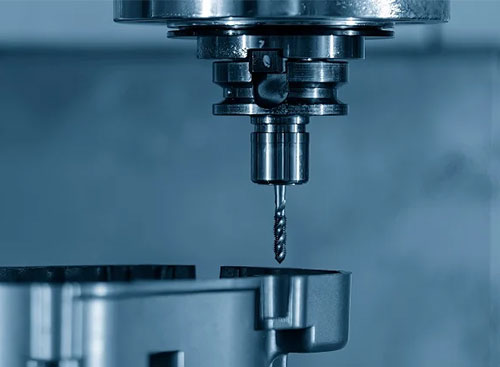
There’s no question that servo motors offer greater accuracy, faster speeds, and reduced heat buildup in CNC applications. Yet this motor option is still less commonly utilized within the industry. If you’re left wondering to yourself, “Are servo motors worthwhile in CNC applications?” They absolutely can be. You just might not yet be asking the right question.
So, here’s a real question you’ll need to consider: What happens when you need to rigid tap a hole and your spindle can’t sync to the Z-axis movement? When that’s the problem, servo motors are the answer.
Rigid tapping demands that the spindle and the Z-axis move in perfect coordination. Every rotation of the spindle must match the axial feed, down to the exact thread pitch. Try doing that with a basic setup or an open-loop system, and you’re in trouble. Threads come out inconsistently, taps break, and you waste parts. A more basic stepper motor simply cannot keep up.
With a servo spindle and an encoder, the machine knows exactly where the spindle is at every moment. It can reverse precisely at the bottom of the hole and follow the same thread path back out. No floating tap holder needed, no guesswork, no compromise. Just tap, reverse, and done. Fully automated.
So, are servos worthy of consideration? If you want to run production-level threading with no headaches, they’re not just valuable, they’re essential.
Why Do Servo Motors Outperform Stepper Motors in CNC Applications?
Servo motors outperform stepper motors in CNC work because they’re smarter and faster. Unlike steppers, which move in fixed steps and hope they’re in the right spot, servos constantly check their position using an encoder. This feedback loop enables real-time corrections, resulting in improved accuracy, increased speeds, and smoother motion, particularly under load.
Steppers are ideal for simple tasks and are ideal for beginners or hobbyists. This motor type is cheaper, easy to set up, and provides adequate performance for tasks such as home-based CNC machining, 3D printing, or engraving. Steppers are ideal for working with more basic materials, such as plastic parts, wood signs, or PCB boards. But once you’re cutting harder materials, making tight-tolerance parts, or trying to push faster cycle times, steppers begin to fall short. They can overheat, skip steps, or just not keep up.

A simple stepper motor (left) vs a servo motor, evidenced by the encoder feedback cable (right). Image used courtesy of CanCam
That’s where servos shine. You’ll find them in serious industrial wood CNC machines, CNC mills, lathes, plasma cutters, and industrial robotics, where you need speed, repeatability, and real torque. They also generate less heat because they only draw power when needed. That’s a significant advantage in terms of reliability.
If you’re making small parts or prototypes on a budget, steppers are fine. But if you’re running production, cutting metals, or need precision and speed, servos are a better tool for the job.
Why Are Stepper Motors Often Favored in CNC Machining?
Stepper motors are more commonly used in CNC machining because they are economical. The cost of stepper motors is approachable for hobbyists or small-scale operations while still providing adequate performance for many applications. Lower-range CNC manufacturers tend to equip their machines with stepper motors simply because it keeps the cost of the product low.
Stepper motors operate without an understanding of their current position in rotation. For many tasks, this is perfectly fine. The lack of encoder parts is one of the main reasons these motors are more affordable, and for many, the added costs of a servo motor and its associated control system may not be necessary.
When is a Servo Motor Necessary in CNC Machining?
Servo motors are used in higher-end machines as they provide greater performance. Servos can achieve faster speeds and greater accuracy due to their constant communication of position through an encoder. This feedback loop enables the controller to make real-time adjustments to the motor’s position, resulting in far greater precision under varying loads. Knowing how many points of position the servo motor has moved and whether it has either lost movement or exceeded the allowable limit set forth in the servo drive parameters can be invaluable in applications where accuracy is essential.

A servo motor, along with an inside look at the encoder components that provide feedback. Image used courtesy of Control.com
Another important advantage of a servo motor is that it generally produces less heat, especially during idle or low-load operations. This is because they only draw as much current as needed, unlike stepper motors, which typically run at full current regardless of the load, contributing to unnecessary heat buildup. While more expensive, these characteristics make servo motors better suited for demanding applications where performance and reliability are critical.
Servo motors are invaluable in advanced CNC applications where accuracy, speed, and reliability are essential. Although they may be used less frequently across the industry, this is primarily due to cost, and not because stepper motors perform just as well. For more basic applications, stepper motors are ideal. However, complex applications, such as rigid tapping, require a more advanced machine that can keep up, and in these situations, servo motors shine.