







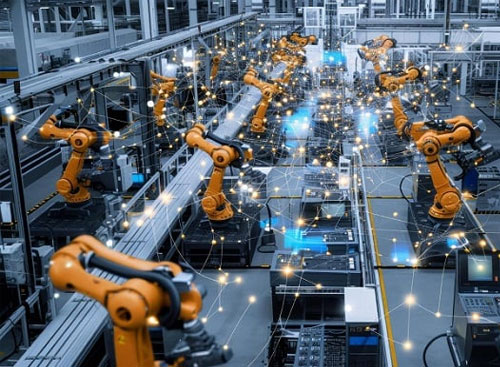
Imagine walking into a modern factory. Conveyor belts glide, robotic arms pivot, and machines hum in perfect harmony. It’s a ballet of automation—until, suddenly, the music stops. One fault, one frozen motor, and the entire line grinds to a halt. In manufacturing, silence isn’t golden; it’s expensive.
Downtime is the nemesis of productivity. Every minute lost means missed targets, mounting costs, and a scramble to restore order. According to Deloitte, unplanned downtime costs manufacturers an estimated $50 billion annually, with nearly 42% of that attributed to equipment failure. But what if factories could anticipate problems before they happen? What if troubleshooting were less about guesswork and more about precision?
Welcome to the era of intelligent diagnostics.

The modern factory relies on instant action, both prevention and reaction when necessary.
The Shift from Reactive to Proactive Maintenance
Traditional diagnostics in industrial settings are often binary: “OK” or “Not OK.” When something goes wrong, operators rely on alarms and basic fault codes. The result? Maintenance teams race against the clock, hunting for the source of failure—sometimes with little more than intuition and a multimeter.
This reactive approach is costly and inefficient. A single hour of downtime in an automotive plant can cost $1.3 million, while in semiconductor fabs, the figure can soar even higher. The stakes demand a smarter solution.
Intelligent diagnostics change the game. By embedding advanced analog I/O components and smart sensors throughout the factory, manufacturers gain real-time visibility into system health. These devices don’t just report faults; they measure voltage, current, temperature, impedance, and more—providing granular data that pinpoints issues before they escalate.
Think of it as moving from a smoke alarm to a full fire prevention system. Instead of reacting to problems, factories can predict and prevent them.
Anatomy of a Smart Diagnostic System
At the heart of this transformation is the ability to collect data. This is clearly illustrated by products such as analog front ends (AFEs). These versatile devices must support a wide range of signals: 0–5, 0–10, ±5, and ±10 volts, as well as 0–20, 4–20, and ±20 mA, and more. But the real power of data collection lies in diagnostic intelligence:
- Real-time signal monitoring across multiple channels
- Open/short detection and cable degradation alerts
- Dual reference tracking to spot drift and component aging
- Clock integrity checks for missing pulses or quartz damage
- Temperature monitoring to catch thermal stress
- Communication error alerts for faster troubleshooting
This isn’t just data collection, it’s actionable insight. Maintenance teams can localize faults, assess severity, and respond with precision.
Why Do AFEs Matter?
AFEs act as the bridge between the analog physical world and digital control systems. Their ability to adapt to multiple signal types reduces hardware complexity and enables universal input/output modules. This flexibility is critical in modern factories where equipment diversity is high.
Redefining Proactive Maintenance
The diagnostic capabilities of these advanced AFEs can fundamentally redefine proactive maintenance by transforming raw signal monitoring into actionable intelligence.
In an evolution beyond traditional analog front ends, newer models integrate all the advanced features mentioned above and more. These diagnostics operate continuously, enabling predictive alerts before faults escalate into failures. For example, by detecting subtle changes in current draw, AFEs can flag early signs of motor bearing damage or mechanical wear—allowing maintenance teams to schedule interventions during planned downtime rather than reacting to costly outages. This shift from reactive troubleshooting to predictive maintenance not only maximizes uptime but also extends equipment life and optimizes operational efficiency across the factory floor.

Analog front ends (AFEs) are a critical building block in the journey from data to insights.
From Component-Level Insight to Factory-Wide Impact
When smart diagnostics are integrated across the factory, every actuator, sensor, and controller becomes part of a self-aware ecosystem. Imagine an actuator drawing abnormal current. Instead of a vague error, the system correlates that data with temperature trends, historical performance, and load conditions—delivering a detailed report to operators.
The benefits are tangible:
- Predictive maintenance prevents unplanned outages
- Faster root-cause analysis for complex failures
- Optimized energy usage through real-time monitoring
- Improved safety by detecting hazardous conditions early
- Regulatory compliance via continuous monitoring
Factories evolve from static systems to dynamic environments—where machines communicate, adapt, and optimize themselves.
Practical Applications Across Industries
- Automotive: Detecting bearing wear in robotic arms before it halts assembly lines.
- Food & Beverage: Monitoring temperature and pressure in pasteurization systems to prevent contamination.
- Semiconductor: Identifying micro-vibrations in wafer handling equipment that could lead to yield loss.
- Pharmaceutical: Ensuring compliance with FDA regulations through continuous sensor validation.
These examples highlight how intelligent diagnostics extend beyond uptime—they safeguard quality, compliance, and brand reputation.
The Human Element: Technicians as Conductors
Let’s not forget the people behind the machines. Intelligent diagnostics empower technicians to act with confidence. Instead of scrambling in the dark, they walk straight to the source of trouble, armed with detailed data and actionable recommendations.
It’s like giving every maintenance engineer a backstage pass to the factory’s inner workings. The result? Less downtime, fewer headaches, and maybe even time for a coffee break.
Challenges and Considerations
While the benefits are clear, implementation isn’t without hurdles:
- Integration complexity: Retrofitting legacy systems requires careful planning.
- Data overload: More sensors mean more data, which requires robust analytics platforms.
- Cybersecurity: Connected diagnostics introduce new attack surfaces.
- Cost justification: ROI must be demonstrated through reduced downtime and maintenance savings.
Manufacturers must weigh these factors against the long-term gains of predictive maintenance.
ROI and Competitive Advantage
Studies show that predictive maintenance can reduce downtime by 30–50% and extend equipment life by 20–40%. For high-volume plants, this translates into millions in savings annually. Beyond cost, intelligent diagnostics enable leaner operations, better resource allocation, and higher customer satisfaction through consistent delivery.

The factory of the future: downtime minimized with equipment life and productivity maximized.
Future Outlook: AI and Edge Computing
The next frontier combines intelligent diagnostics with AI-driven analytics and edge computing. Imagine algorithms that not only detect anomalies but also prescribe corrective actions—or even execute them autonomously. Edge processing ensures these insights happen in real time, without relying on cloud latency.
As industrial automation continues to evolve, intelligent diagnostics will be the unsung heroes, quietly keeping the wheels of productivity turning.
Conclusion: Smarter Factories, Smarter Decisions
The future of manufacturing isn’t just automated, it’s intelligent. Real-time diagnostics, continuous monitoring, and actionable insights are now essential for operational excellence. Factories that embrace this shift gain a competitive edge through higher uptime, lower maintenance costs, and improved safety.
And if you’re lucky, maybe your next factory tour will end with a perfectly timed coffee break—not a frantic dash to fix a mystery fault.