In Stock Hot Product
MDSTB 2,5/ 8-G1-5,08 BD:9-8COD
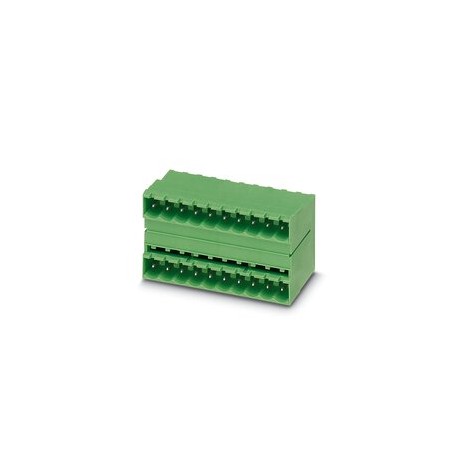
MDSTB 2,5/ 8-G1-5,08 BD:9-8COD 1878943 PHOENIX CONTACT Feed-through header
$0.00USD
3417 in stock
Key Specifications
Note:WEEE/RoHS-compliant, free of whiskers according to IEC 60068-2-82/JEDEC JESD 201
Type:Standard
Pitch:5.08 mm
Result:Test passed
Supplier Information
Products: 0
Usually ships within 2-3 business days
Quality Guaranteed
Fast Shipping
Technical Support
Technical Specifications
| Parameter | Value |
|---|---|
| Note | WEEE/RoHS-compliant, free of whiskers according to IEC 60068-2-82/JEDEC JESD 201 |
| Type | Standard |
| Pitch | 5.08 mm |
| Result | Test passed |
| Color () | () |
| Amplitude | 0.35 mm (10 Hz ... 60.1 Hz) |
| Frequency | 10 - 150 - 10 Hz |
| Width [w] | 42.2 mm |
| Height [h] | 32.5 mm |
| Length [l] | 22 mm |
| Pin layout | Linear pinning |
| Sweep speed | 1 octave/min |
| Product line | COMBICON Connectors M |
| Product type | PCB headers |
| Hole diameter | 1.4 mm |
| Mounting type | Wave soldering |
| No. of cycles | 25 |
| Specification | IEC 60512-1-1:2002-02 |
| Number of rows | 2 |
| Pin dimensions | 1 x 1 mm |
| Product family | MDSTB 2,5/..-G1 |
| Thermal stress | 100 °C/168 h |
| Mounting flange | no |
| Contact material | Cu alloy |
| Corrosive stress | 0.2 dm3SO2on 300 dm3/40 °C/1 cycle |
| Installed height | 29 mm |
| Type of packaging | packed in cardboard |
| Contact resistance | 1.2 mΩ |
| Nominal current IN | 10 A |
| Nominal voltage UN | 320 V |
| Notes on operation | In accordance with IEC 61984, COMBICON connectors have no switching power (COC). During designated use, they must not be plugged in or disconnected when carrying voltage or under load. |
| Degree of pollution | 3 |
| Dimensional drawing | |
| Insulating material | PA |
| Number of positions | 8 |
| Number of potentials | 16 |
| Rated voltage (II/2) | 630 V |
| Contact resistance R1 | 1.2 mΩ |
| Contact resistance R2 | 1.2 mΩ |
| Number of connections | 16 |
| Rated voltage (III/2) | 320 V |
| Rated voltage (III/3) | 250 V |
| Solder pin length [P] | 3.5 mm |
| Test duration per axis | 2.5 h |
| Surface characteristics | Tin-plated |
| Insulating material group | I |
| Solder pins per potential | 1 |
| CTI according to IEC 60112 | 600 |
| Rated surge voltage (II/2) | 4 kV |
| Tested number of positions | 20 |
| Insertion/withdrawal cycles | 25 |
| Rated surge voltage (III/2) | 4 kV |
| Rated surge voltage (III/3) | 4 kV |
| Ambient temperature (assembly) | -5 °C ... 100 °C |
| Contact resistance R22nd level | 2.1 mΩ |
| Ambient temperature (operation) | -40 °C ... 100 °C (dependent on the derating curve) |
| Rated insulation voltage (II/2) | 630 V |
| Rated insulation voltage (III/2) | 320 V |
| Rated insulation voltage (III/3) | 250 V |
| minimum creepage distance (II/2) | 3.2 mm |
| Power-frequency withstand voltage | 2.21 kV |
| minimum creepage distance (III/2) | 3 mm |
| minimum creepage distance (III/3) | 3.2 mm |
| Withdraw strength per pos. approx. | 6 N |
| Insertion strength per pos. approx. | 8 N |
| Relative humidity (storage/transport) | 30 % ... 70 % |
| Flammability rating according to UL 94 | V0 |
| Impulse withstand voltage at sea level | 4.8 kV |
| Metal surface contact area (top layer) | Tin (5 - 7 µm Sn) |
| Ambient temperature (storage/transport) | -40 °C ... 70 °C |
| Comparative tracking index (IEC 60112) | CTI 600 |
| Metal surface soldering area (top layer) | Tin (5 - 7 µm Sn) |
| Metal surface contact area (middle layer) | Nickel (2 - 3 µm Ni) |
| Contact holder in insertRequirements >20 N | Test passed |
| Metal surface soldering area (middle layer) | Nickel (2 - 3 µm Ni) |
| Insulation resistance, neighboring positions | > 5 MΩ |
| minimum clearance value - non-homogenous field (II/2) | 3 mm |
| minimum clearance value - non-homogenous field (III/2) | 3 mm |
| minimum clearance value - non-homogenous field (III/3) | 3 mm |
| Glow wire flammability index GWFI according to EN 60695-2-12 | 850 |
| Glow wire ignition temperature GWIT according to EN 60695-2-13 | 775 |
| Temperature for the ball pressure test according to EN 60695-10-2 | 125 °C |
Product Description
PCB headers, nominal cross section: 2.5 mm2, color: green, nominal current: 10 A, rated voltage (III/2): 320 V, contact surface: Tin, contact connection type: Pin, number of potentials: 16, number of
Key Features
- Industrial grade quality
- RoHS compliant
- CE certified
- 1-year warranty
Product Documents
Datasheet
Technical specifications and performance data
User Manual
Installation and operation guide


